Climate change is already having a profound effect on our wildlife - some species are moving northwards in response to a warming climate. Many species, however, are not mobile enough to be able to do this in time or have specialist habitat requirements; this makes them especially vulnerable to climate change.
Our nature reserves play an essential part in supporting these species but our management of these reserves must be adaptable to ensure species continue to thrive.
As humans, we need relatively large scale changes in a landscape to notice a change in temperature, but for many of our smaller species, such as butterflies, small changes in topography or vegetation structure can make a big difference to the temperatures they experience. By moving between different microclimates, for example, moving from a south-facing slope to a north-facing slope or from open to scrubby habitats, insects can help regulate their body temperature.
Studying the effects of microclimates
As Evidence Champions, we aim for all our conservation work to be evidence-led with habitat management decisions based on sound science. No experimental projects have yet investigated the effectiveness of creating microclimates by varying topographies to help species buffer against climate change, nor the best management strategies to achieve this. This innovative project builds on a collaboration lasting over 15 years between the Wildlife Trust and the University of Cambridge’s Insect Ecology Group, who are at the cutting edge of research in this area.
Banking on Butterflies is one of a suite of projects within the Wildlife Trust movement that are trialling innovative ways to use nature to mitigate and adapt to the effects of climate change. The Nature Based Solutions Fund receives a grant from players of People’s Postcode Lottery, which enabled us to do pre-works monitoring and build four banks at our Totternhoe Quarry nature reserve in Bedfordshire in 2021. Complementing this, four identical banks were built at our Pegsdon nature reserve in 2021, funded by the Cambridge Conservation Initiative (CCI) who were also funding a PhD student researching chalk grassland butterflies. These sites were chosen as the initial sites as they support important populations of not only butterflies but also other insects and specialist plants. Funding from this CCI project enabled us to build another set of four banks at Trumpington Meadows, Cambridgeshire in 2025. A separate CCI project has funded the construction of these banks in Wiltshire at Coombe Bissett nature reserve (Wiltshire Wildlife Trust) and Winterbourne Downs (RSPB) in 2024, as well as ongoing monitoring of all the banks by university staff and students.

The Duke of Burgundy butterfly is one of the stars of Totternhoe reserve but is vulnerable to climate change as it lives in isolated populations and doesn’t disperse far.
Altering the landscape
The banks are located within flat, ex-arable areas and are 15 metres long and two metres high, with arms creating sheltered valleys on one side. This shape was chosen to ensure consistent monitoring. Each bank faces different directions of the compass, to produce more varied temperature conditions for butterflies and other species. We carried out extensive monitoring of the site before and after the banks were built to assess changes in microclimates, and how this then affects the invertebrates and plants using the site.
We will also be producing information on the importance of microclimates and guidance on how landowners can create microclimates on their sites.

A model showing the scale of the banks
Building the banks
Following intensive surveying during the spring and summer the initial banks were built in September 2021 with other sets following in 2024 and 2025. Monitoring continuing in autumn 2021 and during the following years. This allows experimental assessment of whether the banks provide the right conditions for temperature-sensitive species.
From 2022 the banks are being monitored by Matt Hayes, PhD student with the Insect Ecology Group at Cambridge, with help in 2025 from MPhil students Rosa Pollard Smith and Rosalind Mackey. They have repeated all the surveys carried out before the banks were built, monitoring the temperature across the banks as well as the butterflies, plants and other invertebrates using them. Working in partnership with the Insect Ecology Group allows the Wildlife Trust to be at the cutting edge of research in this area, and results then feed straight back into our reserve management.
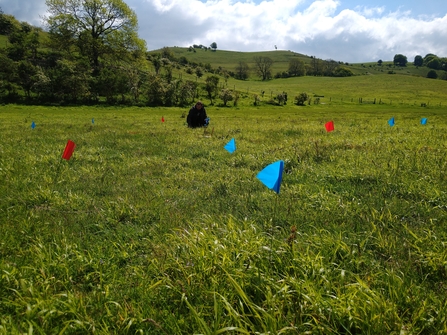
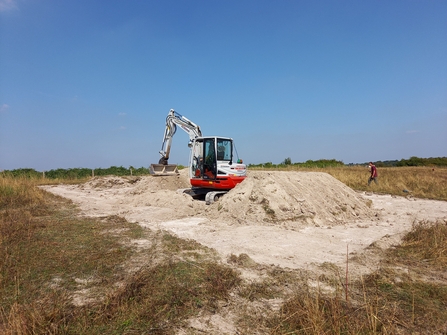
Butterfly Bank construction. Photo by Gwen Hitchock
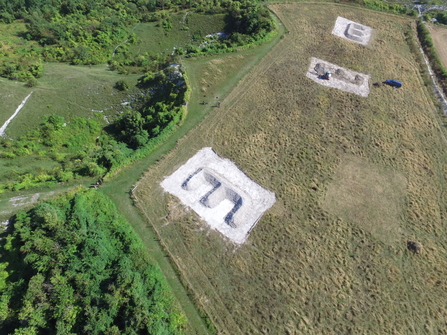
Arial view of the banks being built at our Totternhoe Nature Reserve, each bank faces a different direction
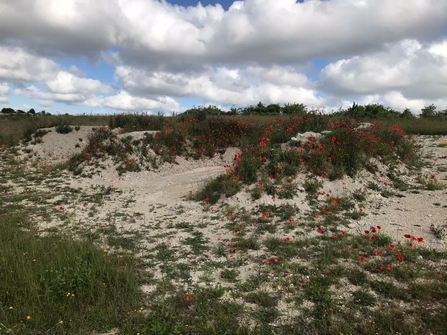
Butterfly bank starting to vegetate up in 2022. Photo by Matt Hayes
Banking on Butterflies BBC News (https://www.youtube.com/watch?v=57Rp98b134A)
BBC News report on the project - courtesy of Richard Westcott (September 2021)
Turning up the heat…
The record-breaking heatwave during the summer of 2022 offered the chance for us to collect some completely new and extremely important data. Under normal conditions butterflies are recorded throughout the open parts of the field as the banks are still quite bare, with few caterpillar food plants and nectar sources.
On July 19th 2022 the UK experienced the hottest day ever recorded, with highs exceeding 40°C. This gave a sobering snapshot of what future climates in this country could look like. During these extreme temperatures, Matt headed out to survey the butterfly banks and surrounding field at Pegsdon recording all the butterflies observed.
His findings turned out to be a mix of being both extremely worrying and exciting...
In the midday heat, absolutely no insects were flying. In the open grassland just two butterflies were seen hunkered down in the long grass. In contrast, butterflies were reliably found on the shaded sides of the banks, with each slope harbouring multiple, inactive individuals hiding from the sun. Just outside the survey area there is a patch of woody scrub that provided some additional shade. Looking here Matt found groups of butterflies and other insects, including hoverflies, all resting together amongst the cool vegetation. It seemed that the 40°C temperatures were simply too warm for insects to be active, and they all huddled together, making use of the only shade available.

During the extreme temperatures of the 2022 heatwave butterflies sough out the cooler, shaded areas provided by the butterfly banks and vegetation.
Whilst this is a worrying peek into what the future might hold for local wildlife, it shows that the banks do work by providing a refuge from extreme temperatures.
Rosa's project also supports this. As well as helping with the monthly butterfly surveys on the banks, Rosa’s main focus was understanding how butterfly behaviour changed with temperature. Her research has confirmed that butterflies show stronger preferences for cooler, more sheltered, more shaded and higher perches as air temperatures rose.
All of this highlights the importance of localised variation in habitat and temperature within sites and across landscapes to allow our local wildlife to survive. As climates continue to change, it will become increasingly important to keep nature reserves varied, managing them for a mix of habitats and temperatures, providing as many options as possible for species struggling to survive in a rapidly changing world.
Matt's research has been published in the Journal of Insect Conservation and is available to read online here.
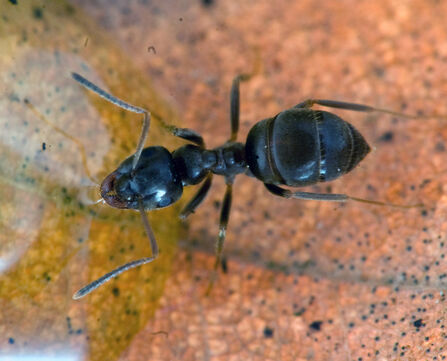
WildNet - Don Sutherland
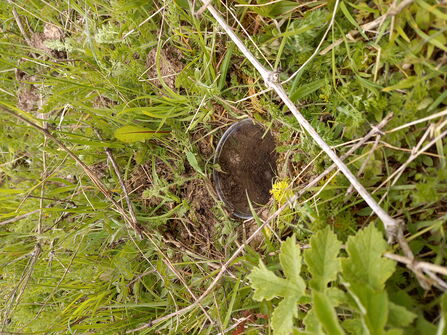
Pitfall trap before lid is added. Gwen Hitchcock
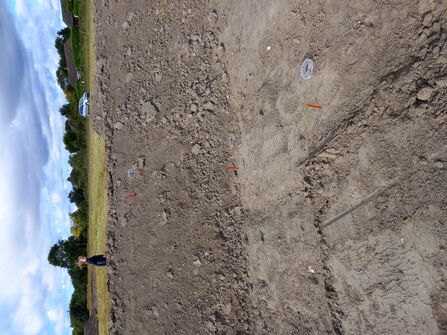
Pitfall traps on butterfly bank. Ryan Clark
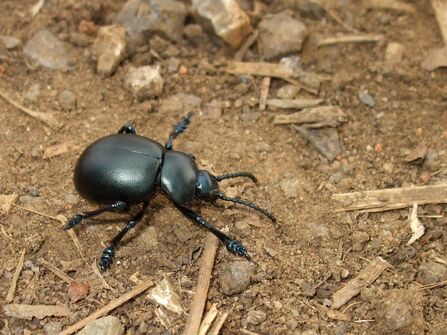
Bloody-nosed beetle. Gwen Hitchcock
Providing habitat other invertebrates
As well as the butterflies, surveys were conducted for ground-dwelling invertebrates using pitfall traps set up across the banks ad adjacent areas. Analysing these Rosalind has discovered that whilst the initial creation of banks caused a decrease in invertebrate abundance, within a few years the banks held many more invertebrates than the surrounding grassland. They also held a slightly different assortment of invertebrates, suggesting that creating habitat diversity by building banks can increase the diversity of invertebrates in the reserves.
She was also able to look at the distribution of invertebrates across the bank area. Comparing this with weather data she found invertebrates used the northern and eastern slopes to shelter from westerly winds. This shows that the variation provided by features such as these banks is beneficial, not just against affects of temperature but also other weathers which are likely to alter with climate change.
Advice for land managers
The lessons we are learning from these banks can be applied to other feature on a larger or smaller scale. Our advice to those looking to add features to their land is to make sure you provide a variety of aspects, with south-facing areas for butterflies and others to warm up but also north-facing and shaded areas for them to cool down during heatwaves. The exact size and shape you provide will vary with what land and resources you have available, as well as personal preference.
Expanding on this and thinking of other extreme weather we have been experiencing then areas of vegetation that are more sheltered from strong winds and higher ground or vegetation safe from flooding are also likely to become increasingly important.
If you would be interested in building a set of experimental banks on your land to help us gather more data for this research then please get in touch. The project has already expanded to Wiltshire with the Wiltshire Wildlife Trust and RSPB building their own sets of banks and a fifth set will be appearing on one of our Cambridgeshire reserve soon...
Contact us
For more information, please contact:
Gwen Hitchcock – Senior Monitoring and Research Officer
Additional information


Pegsdon Hills and Hoo Bit nature reserve in late September 2019 - Robert Enderby
Pegsdon Nature Reserve
Steep hills and tranquil valleys with flower-rich grazed meadows in the chilterns.

Totternhoe Nature Reserve
The result of medieval quarrying with an array of chalk-loving wildflowers.
